- Shop All Documents + Bundles
- FORS V7.1 Document Bundle | Bronze (15 Policies)
- Transport Manager Compliance Pack (10 Policies)
- Transport Manager Compliance Pack (6 Policies)
- Health & Safety Policy Template
- Fuel, Emissions And Air Policy Template
- Operational Security Policy Template
- Serviceability And Roadworthiness Policy Template
- Road Traffic Collision Policy Template
- Counter Terrorism Policy Template
- Load Safety Policy Template
- Vehicle Routing And Scheduling Policy Template
- Driving Standards Policy Template
- Driving Hours Policy Template
- In Cab Technology Policy Template
- Passenger Safety Policy Template
- Complaints And Grievances Policy Template
- Drug And Alcohol Management Policy Template
- Hazard And Risk Identification Policy Template
- VOR (Vehicle Off Road) Policy Template
- Tyre + Wheel Policy Template
- Health & Eyesight Policy Template
- Transport Infringement Policy Template
- Walk Around Check (Defect Check) Tool Box Talk Template
- Transport Manager CV Template
- Social Media Policy Template
- Transport Manager Contract Template
- External Transport Manager Contract Template
- Driver Handbook
A journey from apprentice to fully qualified paint sprayer


A journey from apprentice to fully qualified paint sprayer
Keen to acquire a skilled trade, Harvey Swan, took a two-year apprenticeship with materials handling services company, Rushlift, and now enjoys a career as a fully qualified Level 3 Vehicle Damage Paint Technician. Here, Harvey answers some key questions, giving useful insights into taking an apprenticeship
Starting the Journey
Q: What made you choose an Apprenticeship rather than another route?
A: I wanted to learn a new skill or trade without having to commit 3-4 years at university on a degree that I may not have found interesting. Having worked six years in retail, managing a store, I wanted to do something more.
Q: Why did Rushlift stand out to you when you were looking at opportunities?
A: Through conversing with my friends, Angus and Hansel – both of whom work at Rushlift – about what apprenticeship I could do, Hansel brought up the idea of being a paint sprayer, which sounded interesting and quite unique.
Q: What do you remember most about your first few weeks at Rushlift?
A: Working in a team of likeminded people and being supported through the first few weeks by everyone.
Learning and development
Q: What technical skills have you developed over the past two years?
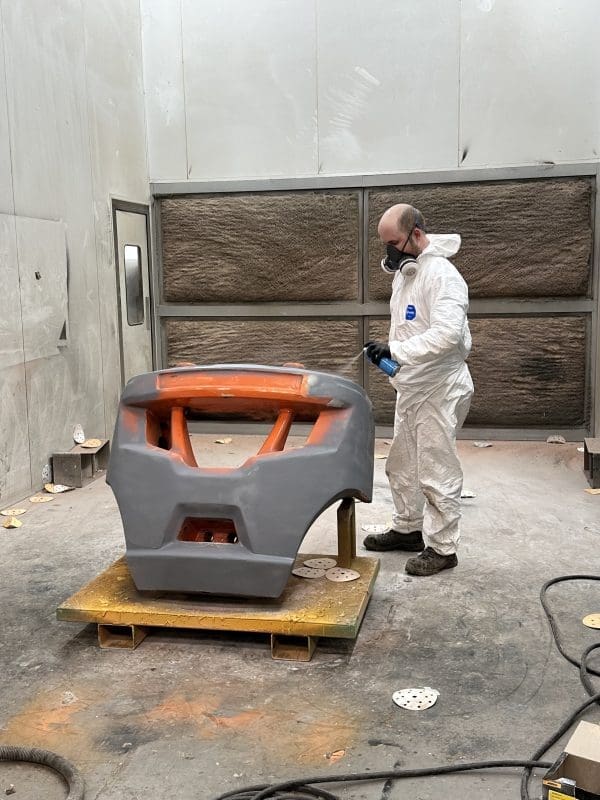
A: Applying direct gloss paint, prepping and refurbishing vehicles ready for painting, stripping apart vehicles, learning about engines – thanks to Barry and Adam, two of the workshop engineers.
Q: What’s something you can do confidently now that you couldn’t at the start?
A: When I first started painting on my own I would always double check with Hansel if the gun was correct or if the paint was mixed correctly, but now I just get on with it.
Q: How did learning on the job compare to classroom-based training?
A: Learning on the job meant I was getting hands-on experience with the preparation of the vehicles, stripping them down and painting them. However, the classroom side was very informative, learning colour theory, how to prepare different paint materials, painting using pearlescent paints for car repairs and a lot more besides.
Q: Was there a moment when things really ‘clicked’ for you?
A: Things really started to click when I needed less supervision from Hansel, and he trusted me to progress with the work. As my confidence and skills grew, I was able to work on more intricate finishes, including two-tone colours and special paint jobs for our Charity Trucks.
Q: What challenges did you face during training, and how did you overcome them?
A: One challenge was on the preparation stage for a forklift counterweight which had a lot of small edges and nooks which required filling and repairing. Hansel showed me different techniques for getting the counterweight to a smooth surface ready for paint.
Another challenge was for my end point assessment, doing a fade-out blend on a clearcoat panel. Hansel and I spent an entire day just practicing getting the invisible blend and we just kept at it until I got the technique locked in place. Non-painters just wouldn’t notice it, but painters can see the difference.


Support from Rushlift
Q: How has Rushlift supported you throughout your apprenticeship?
A: I found the support from my mentor and workshop team really great, as they would help out when they could and were always teaching me new things about the trucks that I wouldn’t have learnt at college – learning about how engines work, taking apart hydraulics, all sorts really.
The training management team, Sam and Steve, at the Rushlift Centre of Excellence, were on top of all the college work, giving me time to practice painting car wings, writing up job cards and even managing to get me some new tools for painting, which were needed!
Q: Can you talk about the role your mentor and colleagues played in your development?
A: Hansel was very supportive, giving me room to develop on my own but was always there to help with any problems or mistakes. He was very understanding, knowing that every painter has different ways of doing things, so he would show me a variety of ways to complete something but never told me to keep to a certain way.
The workshop team were, again, very supportive with helping me out on tight deadlines when we had to get a truck painted and ready to collect in a small timeframe.
Q: How did the business help you balance work, training and assessments?
A: The business gave me time during the week to practice college projects, like painting up car wings in metallic, pearlescent and solid colours or time to do write-ups, and getting the right materials for me to practice for the end-point assessment.
Q: Did you feel encouraged to ask questions and learn from mistakes?
A: I was always encouraged to ask questions. As I’m not an engineer, the engineers, Barry and Hansel, seemed to like it when I asked them questions – they enjoyed teaching me something new.
Barry always found time to show me new things and always explained in detail how they work. Hansel was very understanding when it came to learning from my mistakes, as anything can go wrong when spray painting – from paint runs to paint reacting badly. As he knew that it isn’t always the painter’s fault, he would give me time to rectify any mistakes.
Q: What does the team culture at Rushlift mean to you?
A: The workshop is a very strong, small team and we always help each other out and support one another – even when we’re up against it, we still find time to have a laugh while working hard.
Growing in Confidence & Responsibility
Q: How has your confidence changed over the last two years?
A: I’m now fully confident in just getting on with the next project that come into the workshop for me. Also, I’m much more confident when it comes to asking for a hand when it’s needed, without feeling guilty for taking up someone’s time.
Q: When did you start to feel like a fully contributing member of the team?
A: I felt I was fully contributing once I needed less supervision and was trusted to take more responsibility for projects, completing trucks on time for collection and helping the refurbishment team whenever I could.
Q: Have you been given more responsibility as your skills developed?
A: Well, I’m pretty much responsible for the paint side of the workshop now and for writing up materials lists for preparation work and paint jobs.
Q: What does becoming fully qualified mean to you personally?
A: Being trusted to do the job at hand and earning the qualification to prove that I’m ready for the role in the workshop.
Life After Qualification
Q: How does it feel to complete your apprenticeship and become fully qualified?
A: It’s a relief knowing that I won’t have college work to think about or having to do the end point assessment. But it’s also tremendously rewarding that my hard work has given me a qualification in a trade and a skill that can be adapted to all sorts, from painting forklifts to cars or even aeroplanes.
Q: What are you most looking forward to in the next stage of your career at Rushlift?
A: I’m hoping to do more unique projects for different customers and getting a qualified painters wages is always a positive!
Q: Are there any new skills or qualifications you’d like to work towards?
A: I wouldn’t mind being taught more about the electrical side of the vehicles and learning how to weld is something I’m quite keen to learn.
Q: How do you see your role developing within the business?
A: Perhaps as a team leader or supervisor, but I mainly want to stay in the workshop, as office life has never really crossed my mind as something I would want to do.
Advice to future apprentices
Q: What advice would you give to someone considering an apprenticeship?
A: Look into it, as there so many different types of apprenticeships that you can get into and learning while getting paid is more ideal than going to university and being stuck with debt at the end of it.
Q: What qualities do you think make a successful apprentice at Rushlift?
A: Getting on with the job at hand, always wanting to learn and help out in the workshop, and getting on with your mentor and colleagues will massively benefit you and the workshop.
Q: Why would you recommend Rushlift to someone starting their career?
A: At Rushlift there’s a good supportive team and a variety of different things you can learn and do – from working in a workshop, on-the-road and at the airport.
Closing reflections
Q: What does working at Rushlift mean to you?
A: Working with a good team of people.
Q: What are you most proud of achieving over the last two years?
A: I’m particularly proud of a full respray I did on a Linde truck and of course, I’m really proud of passing my end-point assessment and getting my qualification.
Q: If you had to describe your apprenticeship in three words, what would they be?
A: Learning, Hands-on, Practice
For further information on Rushlift apprenticeships go to www.rushlift.co.uk